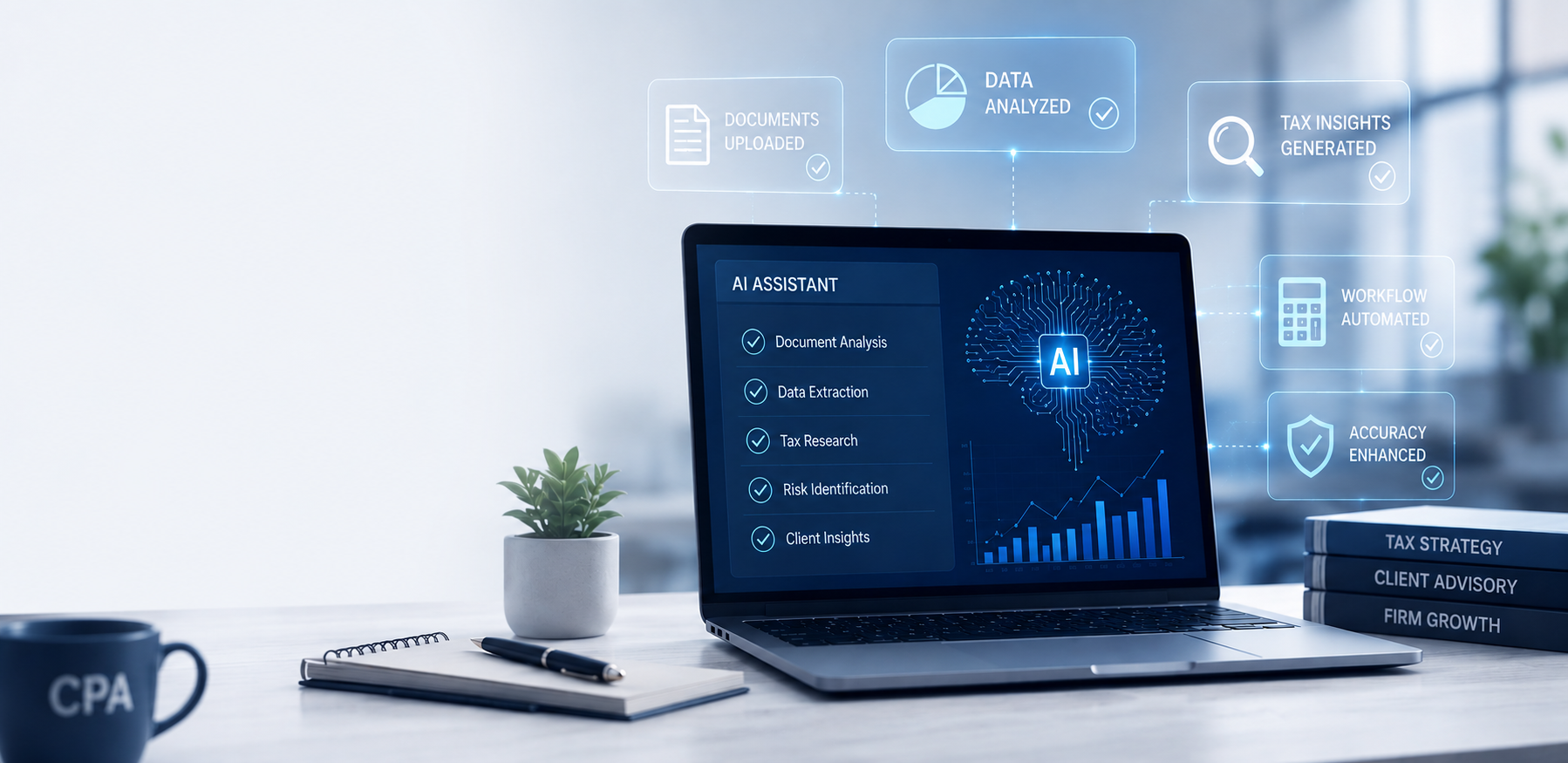
Between January and April 15, filing volumes at most CPA firms run two to three times above baseline. Headcount does not move. So what most firms ask of their people, year after year, is sixty to seventy hour weeks for fourteen weeks straight, with the deadlines fixed.
This past season was harder than usual. The federal tax law changes that hit in 2026 added new deductions, tightened existing ones, and pushed fresh employer reporting into the mix. By April 15, most teams had nothing left.
The pattern repeats. The bottlenecks are the same every year: reconciliation, document ingestion, multi-entity matching, payroll review. The work that consumes the first week of every engagement before any real analysis can start.
The off-season is the only window where you can do anything about it. Six months until the next surge. The firms that use that window to set up real automation walk into next April with a different baseline.
The cost of being wrong, scaled up
The pressure is not just operational. Mistakes at scale show up on the tape.
In 2024, more than 140 public companies were forced to restate their financials. When ADM disclosed an internal accounting investigation, the stock dropped 24 percent in a single day, the company's worst since 1929, and roughly 8.8 billion dollars of shareholder value vanished with it. The SEC brought over 45 enforcement actions involving financial misreporting that same year.
Experienced human reviewers operate at 96 to 98 percent accuracy under normal conditions. The number is reassuring until you ask what it costs to maintain that quality at sixty hours a week in March. Fatigue compounds. So do small misses.
Purpose-built AI for financial document processing operates at 95 to 99 percent accuracy regardless of volume or time of year. The architecture matters here: deterministic code paths and dual verification, not a single LLM guessing. General-purpose chatbots are not the right tool for this. They hallucinate. They are not built for analytics. The point is not "use AI." The point is to use the right kind of AI for the work.
The economics
CPA hourly rates in 2025 land between 200 and 500 dollars depending on seniority, specialty, and market. A mid-size client with multiple entities, multi-state payroll, AP/AR volume, and a full general ledger to reconcile is not a few billable hours. It is weeks of senior time, most of it spent on data prep before analysis begins.
When your senior staff are working seventy-hour weeks at 200 to 400 dollars an hour on document cleanup, the math compounds against you. And because headcount is fixed during peak, you cannot buy that time back by hiring out of it.
Senior judgment applied to risk, strategy, and client decisions is worth every dollar of those hourly rates. Reformatting spreadsheets and matching line items by hand is not.
Where AI actually earns its keep
The workflows that make tax season brutal are also the most automatable. They are repetitive, structured, and high-volume. Exactly what purpose-built AI handles well.
Trial balance and general ledger reconciliation. This is where complexity peaks. Matching entries across periods, identifying anomalies, and ensuring the TB ties out cleanly. A single misclassification distorts the entire P&L picture downstream. Automation handles the matching at scale and flags discrepancies in real time. HighRadius reports up to a 30 percent reduction in days-to-close at organizations using AI for this work.
Bank reconciliation and proof of cash. Continuous matching across accounts and entities. Unmatched items surface immediately rather than during review.
P&L and balance sheet analysis. Beyond organizing the data, AI can identify variance patterns, flag unusual revenue recognition, and surface inconsistencies between periods.
Payroll verification and AP/AR aging. Automated payroll review catches ghost employees, duplicate records, and multi-jurisdiction compliance gaps that get missed under deadline pressure. Aging analysis flags collection risk and payment anomalies without an analyst rebuilding reports from scratch.
The cumulative effect is what matters. The first week of every engagement, the part that consumes ingestion and cleanup time, becomes the starting point. Senior staff start with usable data instead of building it.
Security is not optional
Financial data demands a higher security floor than most categories. The baseline most firms already know is SOC 2 Type II, which audits a vendor's security controls over time rather than at a single point. Above that: ISO 27001 and the NIST AI Risk Management Framework, which addresses risks specific to AI systems. For any firm with clients across state lines or international exposure, GDPR and CCPA apply.
Architecture matters as much as the certifications, and the question worth asking is where the data actually goes.
Private cloud deployment keeps client financials inside your perimeter. The data is not used to retrain any underlying model. Reputable vendors in this space offer pre-trained, purpose-built models that operate in isolation from public AI systems.
If a vendor cannot answer where data is processed, where it is stored, who has access, and whether it is used for training, that is the entire conversation. There are vendors that can answer all of those questions. Pick one of them.
What changes for your firm
Firms using automation report near-unanimous improvements. A 2025 Intuit QuickBooks survey of 700 accounting professionals found 98 percent saw better accuracy, 97 percent saw greater efficiency, and 95 percent reported higher-quality client service.
The longer-term outcome is harder to put on a survey but easier to feel in the office. Senior staff get back to doing the work they were trained for. Junior staff stop being treated as data-cleanup labor. Margins on engagements improve because the highest-cost hours stop being spent on the lowest-value work. And the next April stops feeling like the same April you have already survived ten times.
The firms that move now have six months. The ones that wait will absorb the same lesson the same way they did this year.
A short list before the next season
Before you commit to a tool:
- Verify it is purpose-built for financial document processing, not a general chatbot wrapper.
- Confirm SOC 2 Type II at minimum. Ask about ISO 27001 and the NIST AI Risk Management Framework.
- Insist on private cloud deployment with no model retraining on your data.
- Pilot it on one or two engagements during the off-season, not in March.
- Pick the workflows it owns end-to-end first: reconciliation, ingestion, payroll review. Layer in the harder ones later.
AI will not replace the judgment and the relationships that make great accounting work. It will make those things harder to deliver for firms that keep spending their best people's hours on tasks software can do better.
Sources
- 2026 IRS updates and the impact on tax season outsourcing · Unison Globus, 2026.
- How to avoid tax season stress: a CPA firm survival guide · Datamatics CPA, 2025.
- Financial restatement rate hits nine-year high · CFO Brew, December 12, 2024.
- ADM CFO to resign as company faces US government investigation · Reuters, April 22, 2024.
- Reviewer accuracy benchmarks for financial controls (PDF) · U.S. Government Accountability Office, AIMD-96-98.
- Financial close software: AI for reconciliation and reporting · HighRadius.
- 2025 Intuit QuickBooks Accountant Technology Survey · Intuit QuickBooks, 2025.
- How AI Is Rewriting the Tax Season Playbook for CPA Firms by Nikita Komarov · Unite.AI, May 4, 2026.